Up against the chains and their interchangeable visuals, an independent Pilates studio has one asset nobody can copy: its method, its instructors, the attention given to every student. Here is how to make it visible in photo and video, from the subtitled reel to the instructor portrait.
- 1. Why your studio is not in the same category as a chain
- 2. Show the method and the correction rather than poses
- 3. Put your instructors front and centre
- 4. Subtitled reels: the format that makes Pilates understood
- 5. Students at ease: photographing real bodies with discretion
- 6. Organising a shoot in your Pilates studio
- 7. Mistakes to avoid when marketing a Pilates studio
- 8. Pilates studio marketing: frequently asked questions
- The key points, in summary
Marketing an independent Pilates studio today means competing on crowded ground. The chains open bright, airy studios with polished Instagram feeds, visuals produced at scale and memberships that are easy to compare. On paper, the small neighbourhood studio starts a step behind.
In reality, it has exactly what those brands struggle to show: a method passed on by instructors students know by their first name, private sessions and small groups where every movement is watched, corrected and adjusted. That is precisely what someone is looking for when she is torn between two studios. You just have to show it to her.
At Agence Dubois we photograph and film Pilates studios and independent instructors across the Paris region. Here is our practical take on what makes the difference on camera.
1. Why your studio is not in the same category as a chain
A chain sells a reproducible concept. Its visuals are designed to work in every city at once: flawless bodies in matching outfits, uniform lighting, poses held for the lens. It is effective for building a brand, far less so for building a relationship.
Your studio sells something else: a human-scale experience. An instructor who remembers your slightly stiff shoulder, a reformer set up for you. That kind of value does not come across in a catalogue shot. Borrow the codes of the big brands and you put yourself on their ground, the ground of price and volume.
So the right question is not "how do I look as professional as a chain?" but "how do I show what a chain cannot?". The answer comes down to four ideas: the method, the instructors, teaching through video and students who feel at ease.
2. Show the method and the correction rather than poses
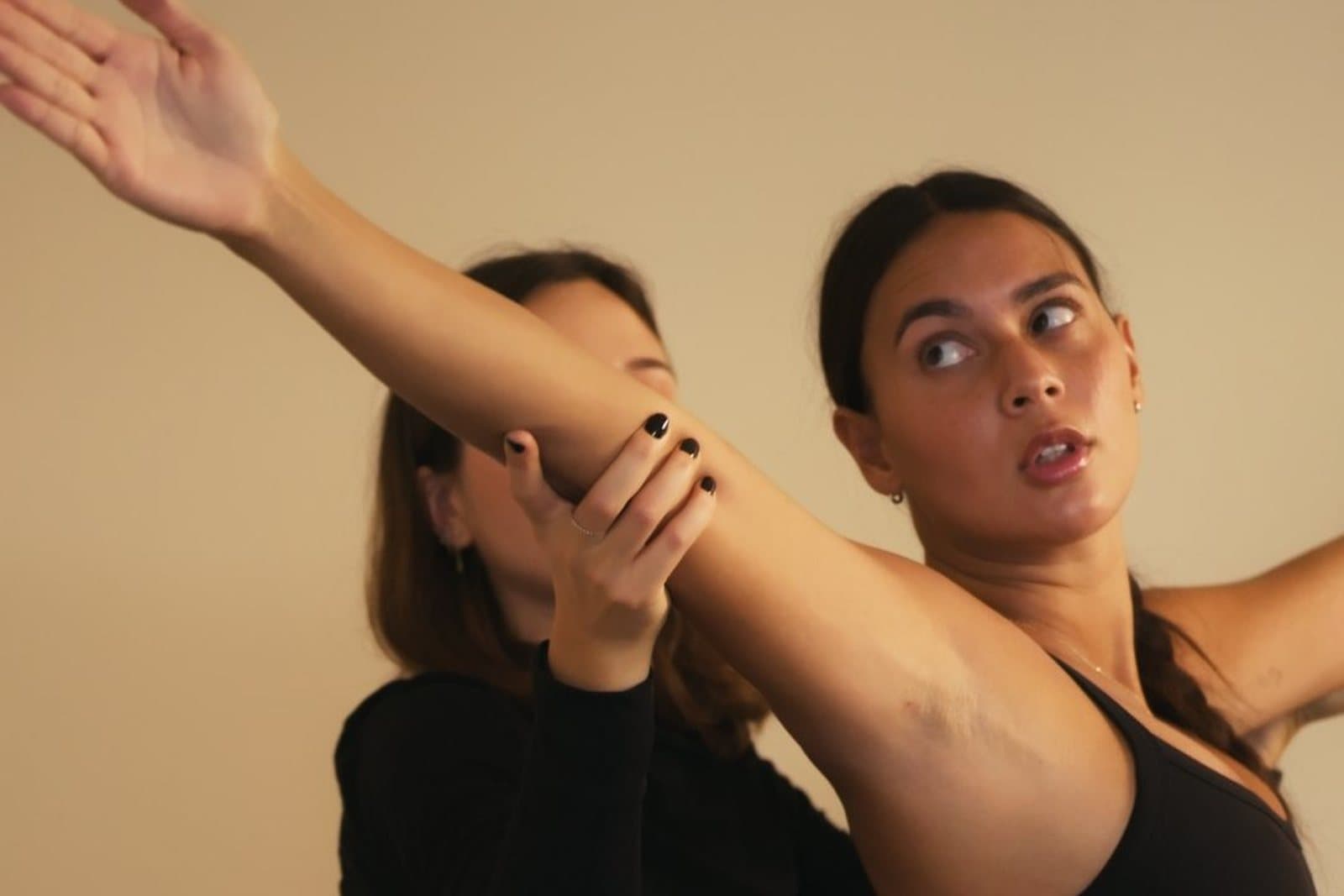
The most common reflex when photographing a Pilates studio is to ask a student (or the instructor herself) to hold a spectacular position. The result is often beautiful, but it tells a story of performance, not of guidance. Someone who is just starting out, or coming back to exercise after a long break, cannot picture herself there.
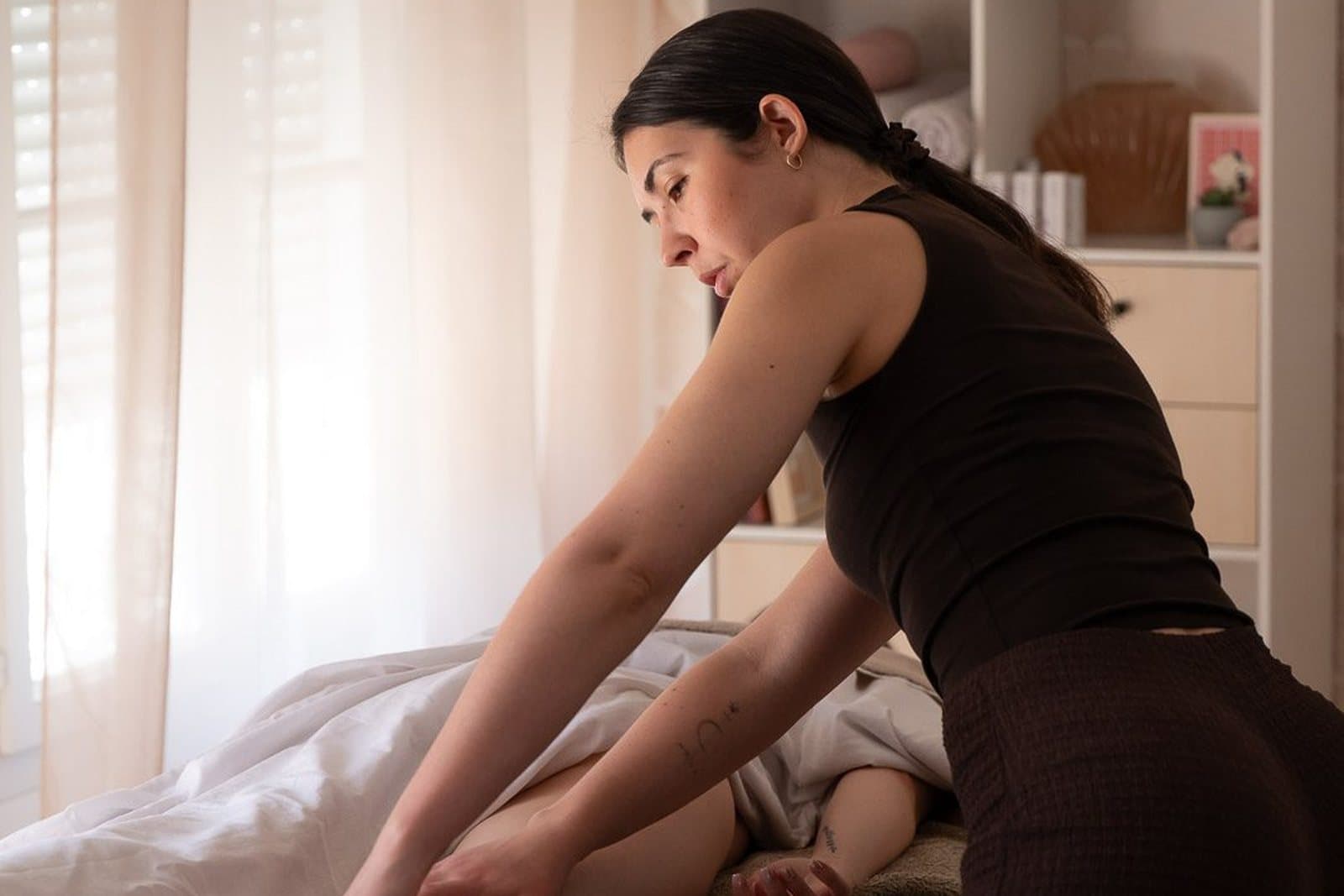
What sets a good class apart is the correction. A hand on a shoulder blade to open the ribcage. A finger pointing out the alignment of the pelvis. A spring the instructor changes on the reformer before the exercise. A glance exchanged between two reps. These moments are quiet and fleeting, and they are exactly what you want to capture.
What we look for on camera
- The instructor's hands: guiding, adjusting, a light and caring touch.
- Equipment details: springs, straps, the reformer carriage, small props, all of which speak to the precision of the practice.
- Before and after a correction: the same position filmed twice, before and after the cue, with no unnecessary commentary.
- The student's focused face, rather than her body at full extension.
This approach speaks directly to your future student. She no longer thinks "I'll never manage that", but "there, they will help me do it properly". It is a promise about teaching, not about physical results, and that is what makes it credible. Be careful, too, with the words that go with these images: talk about posture, body awareness and alignment, never about fixing back pain or rehabilitation, which belong to health professionals.
To see how we approach this kind of session in practice, our editorial shoot page sets out how we work.
3. Put your instructors front and centre
In an independent studio, the instructors are the brand. Students stay for a person: their voice, the way they explain things, sometimes their sense of humour. Yet many studios barely show them, for fear of making their communication too personal or of depending on one individual.
You should do the opposite. Someone hesitating over booking a first private session wants to know who she will be spending that hour with. A face, a background, a way of teaching: that is what eases the apprehension.
The content that works
An editorial portrait of each instructor. One or two photos, posed but natural, in the studio, in its own light. No white backdrop, no fitness magazine pose. Your space should be recognisable behind the person.
The instructor in motion. A few shots of them demonstrating an exercise, then guiding a student through it. The contrast between the two says everything about their teaching.
The instructor's voice. A short piece to camera explaining one simple principle: why you work on lateral breathing, what the reformer changes compared with the mat, what happens in a first private session. Thirty seconds is enough, as long as it is well framed and well lit.
That is what we did for L'Adresse Pilates, a private-session studio in Paris's 16th arrondissement: reels and photos shot with the instructors, each in their own role. On the studio side, what Krizia values most is "being able to delegate with complete confidence", which matters as much as the images themselves when you are running a class timetable.
4. Subtitled reels: the format that makes Pilates understood
Pilates is a discipline that needs explaining. Without context, a reformer video looks like any other workout. With three well-placed lines, it becomes a mini lesson that shows your expertise.
This is where subtitles change everything. A lot of Instagram videos are watched with the sound off, on public transport or at the end of the day. A subtitled reel can be understood in silence and gets shared more easily.
How to build an effective Pilates reel
A clear hook from the very first second. A simple question or promise: "Why does your instructor ask you to draw your navel in?", "What we adjust before every exercise on the reformer".
A short, readable demonstration. One exercise, one correction, one visible change in posture. No frantic editing: Pilates is filmed in calm shots that give the eye time to follow the movement.
Subtitles that look like you. Your brand's typeface and colours, placement that never hides the movement, a comfortable reading pace. Subtitles are part of your visual identity, just like your logo.
An ending that invites action. "A first private session is about understanding your body before working it": a gentle line that leads towards booking, without pressure.
To go further on how reels work for care and wellness businesses, our article on video for beauty salons and spas covers the formats and how to prepare them. The principles translate very well to a Pilates studio.
5. Students at ease: photographing real bodies with discretion
A Pilates studio welcomes a wide range of people: new mothers, busy professionals, dancers, older students, nervous beginners. If your visuals show only one body type, part of your potential clientele feels left out before they even arrive.
Showing real students, of every age and build, is a genuine sign of welcome. But it calls for a respectful way of shooting.
Our guidelines for a relaxed shoot
- Let people know in advance. Students attending on the day should be told beforehand and be free to choose whether to take part. Those who would rather not appear stay out of frame, with no need to explain.
- Collect written image consent from every recognisable person, specifying the intended uses (website, social media, print).
- Work with a small team and natural light wherever possible. Less equipment means less intimidation and more natural body language.
- Favour flattering framings: profiles, hands, details, shots from behind, focused faces rather than frozen poses.
- Let the class happen. The best images come when students forget the camera. We film a real moment of a class, not a staged one.
These guidelines are no substitute for advice from a lawyer or your professional federation, particularly on image rights. But they lay the groundwork for a shoot where everyone feels respected, and that shows in the pictures.
6. Organising a shoot in your Pilates studio
A well-prepared shoot gives you visual capital you can use for months. Here is how we organise it with the studios we work with.
Before the day
We start with a conversation about your signature classes (reformer, private sessions, small groups) and the priority shots: instructor portraits, correction sequences, atmosphere, equipment. Ideally the slot is built around a real class, with volunteer students.
Choosing the right package
For a studio laying the foundations, the Flash Essentielle package (€450 excl. VAT, 2 hours on site, 5 retouched photos, 1 editorial reel and 4 short videos) produces instructor portraits and a first subtitled reel. Flash Émotion (€750 excl. VAT, 4 hours, 10 photos, 2 reels, 7 short videos) leaves time to film several instructors and several types of class. For a studio that wants to tell its story, Flash Signature (€950 excl. VAT, 6 hours, 15 photos, 1 styled interview, 2 reels, 12 short videos) adds an interview with the founder. All the details are on our editorial shoot page.
Delivery takes between two weeks and a month (an indicative timeframe), with unlimited web use. If you would rather hand over your whole Instagram presence, our Réseaux packages combine a monthly shoot, copywriting for your posts and scheduling.
7. Mistakes to avoid when marketing a Pilates studio
Copying the chains' aesthetic. White backdrops, matching outfits, spectacular poses: you gain polish and lose what makes you unique. Your light, your walls and your instructors are worth more than a neutral set.
Showing only professional-level bodies. If every image shows dancers at full extension, a beginner cannot picture herself there. Mix profiles and levels.
Promising health outcomes. "Say goodbye to back pain", "guaranteed rehabilitation": wording like this raises issues of credibility and professional ethics. Talk about posture, body awareness, gentle strengthening and wellbeing.
Posting videos without subtitles. A silent demonstration loses a large part of its audience. Subtitles are not a technical detail; they are what makes your teaching readable.
Staying anonymous. A studio without faces looks like just another chain. Your instructors are your best argument: show them.
8. Pilates studio marketing: frequently asked questions
Do you need a specialist Pilates photographer for your studio?
It is not essential, but it makes a real difference. A photographer who knows the discipline can anticipate a correction, spot the moment the alignment is right and avoid angles that distort a position. They also know how to stay discreet during a class, which puts students at ease.
What should a Pilates studio post on Instagram?
Alternate instructor portraits, subtitled teaching reels, equipment details and studio atmosphere. Add practical content regularly: what happens in a first class, the difference between reformer and mat, how to choose between a private session and a small group. Pilates videos like these on Instagram are what reassure future students.
Can you film during a real class with students?
Yes, and it is what produces the most honest images. You simply need to tell students in advance, collect their written image consent and keep anyone who would rather not appear out of frame. A small team and minimal equipment are enough to preserve the atmosphere of the class.
How much does a shoot for a Pilates studio cost?
Our Flash packages range from €450 excl. VAT (2 hours on site) to €950 excl. VAT (6 hours, including a styled interview). A bespoke quote is always possible for specific needs.
How can an independent studio stand out from the big brands?
By leaning on what they cannot reproduce: the relationship with the instructors, the attention given to each student, the quality of the correction. Your communication should make these visible, with genuine images shot in your own studio rather than generic visuals.
The key points, in summary
An independent Pilates studio does not stand out by imitating the chains, but by owning what makes it singular. Show the correction rather than the pose, put your instructors front and centre, explain the method in subtitled reels, photograph real students with respect: these four choices are enough to turn an Instagram feed into a showcase for your teaching.
Future students are not looking for the most spectacular studio. They are looking for the place where they will feel looked after. Your images should show them that before the very first class.
At Agence Dubois we work with Pilates studios and independent instructors across the Paris region, with bespoke shoots and subtitled reels in your brand style.
If you would like to talk it through, book a free 30-minute discovery call. We will discuss your studio, your instructors and how to show what makes you unique.
Agence Dubois is a digital communication studio dedicated to the beauty and wellness professions, based in Chessy and working across the whole Paris region. Photography, video and editorial strategy for beauty salons, spas, Pilates studios and wellness practitioners.
- Pilates studio marketing
- Pilates video Instagram
- Pilates photographer
- stand out Pilates studio
- subtitled Pilates reels
- Pilates studio photoshoot
- Pilates instructor marketing
- reformer Pilates Instagram
- independent Pilates studio